
Brewery cities

I stumbled across a TikTok that made me reevaluate how the culture within many American cities influences our socialization habits and might be a hindrance to certain residents’ social lives. In the video, the creator remarks that within the context of American cities, you either live in a ‘good’ city, where there’s plenty of different activities available for folks to socialize at and build community with one another, or brewery cities, where the majority of the city’s social scene is dominated by craft breweries.
There’s something to be said about the role of alcohol in our socialization patterns over the course of history, which is quite significant to say the least. Humans have fermented all sorts of crops to brew intoxicating beverages for thousands of years, and many cultures all across the world are rooted in the shared consumption of alcohol in a public setting. This is where we get the ‘pub’ from, short for public house, which has in some form served as an institutional anchor for communities worldwide for centuries.
In modern times, the craft brewery has come to dominate the American urban landscape. They’ve popped up all over in the past twenty or so years. Odds are the newest establishment opening up around the block is a brewery. Durham has developed a reputation as a major mid-sized hub for breweries, as have many other cities across North Carolina. Oftentimes when you’re meeting up with friends nowadays, your destination is likely a brewery. This extends to social groups as well– language clubs, run clubs, trivia groups, social bike rides, and more all meet (or at least end) at one of Durham’s many breweries. Durham has tons of community-building opportunities to offer to its residents, but among the working professional crowd it’ll center almost entirely around the brewery.

Durham’s largest social bike ride, the Pony Ride, occurs on the second Tuesday of every month. The ride concludes with a social gathering at Ponysaurus Brewery, where riders can win brewery gift cards and other alcohol-related prizes.
There’s three observations I’ve made about this near-monopoly breweries hold on the way we socialize, be it here in Durham or more broadly across the country. For starters, it can get pretty old pretty fast. There are only so many different types of beer and so many different types of venues until all breweries will generally have the same retro-factory feel with brick walls and exposed pipes. If not that vibe, there’s only so much variation in the different types of breweries until an establishment needs to truly set itself apart from the pack to be considered remarkably unique. This sameness can consequently strip the individuality of a community, particularly when the same exposed brick and pipe brewery can be found in cities across the country.
My other observation is one of exclusion. In the United States, roughly a third of the entire adult population doesn’t drink1. This ranges from those who don’t drink due to medical conditions, to those struggling with alcoholism, to those who simply don’t fancy themselves a beverage. That’s a significant portion of the population that doesn’t have all that many adequate alternatives for meeting up with friends after work if they happen to live in one of these so-called brewery cities. Even with the alcohol-free options present at some breweries, some might feel stigma around ordering these beverages or may not even feel comfortable in an establishment that almost exclusively serves alcohol.
Finally, an American brewery city is also likely going to be a car-dependent one. Take our neighbor to the south; Charlotte, North Carolina. Because of its close proximity to Asheville, a brewery haven, there is a large craft brewery presence in the city. Young professionals flock to the breweries in South End, NoDa, and many of Charlotte’s other up-scale neighborhoods to meet up with friends and a variety of social groups. These neighborhoods’ social scenes are rooted in their brewery culture.
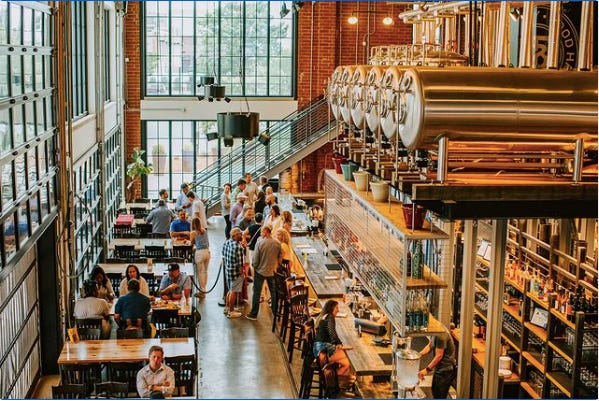
Trolly Barn Fermentation & Food Hall in Charlotte’s South End.
However, Charlotte is a notoriously car-dependent city; walkscore.com rates it as the sixth least walkable city in the entire country, and Charlotte’s mobility culture is heavily centered around the automobile despite its fledgling light rail system2. Unless they happen to live in the brand-new, expensive apartments built right next to the brewery, patrons are almost always driving there. This is extremely dangerous if folks are engaging in moderate to heavy drinking right before getting behind the wheel, which is often the case. The unholy matrimony of brewery culture and car culture puts all people on the road in serious risk of injury or even death at the hands of drunk driving.
I hope this post hasn’t indicated any sort of bias against alcohol or breweries from me. I do enjoy frequenting many of Durham’s breweries, although my preference will always be a Miller High Life at a familiar haunt. However, I’m wary of the absolute stranglehold breweries have over the social scene in many of our cities. Only in the most diverse, vibrant, and yes, walkable cities in the United States does it feel there’s any sort of social scene beyond the brewery.
This isn’t to say that Durham is a boring city by any means; we punch above our weight with the wide array of amenities our fair town offers, most notably with Durham Bulls baseball games. However, the brewery dilemma brews monotony, exclusion, and unsafe driving habits that can only hamper our socialization. At their best, cities are lively cultural centers that should offer folks of all backgrounds and drinking preferences the opportunity to gather and foster community with one another.
Sources
‘Heavy Drinking Among U.S. Adults, 2018,’ Center for Disease Control and Prevention. https://www.cdc.gov/nchs/products/databriefs/db374.htm#:~:text=In%202018%2C%205.1%25%20of%20adults,consume%20alcohol%20(Figure%201).
‘Charlotte, North Carolina,’ Walkscore.com. https://www.walkscore.com/NC/Charlotte.
Breweries? Where are all the wineries? ;)
Important topic and great article!